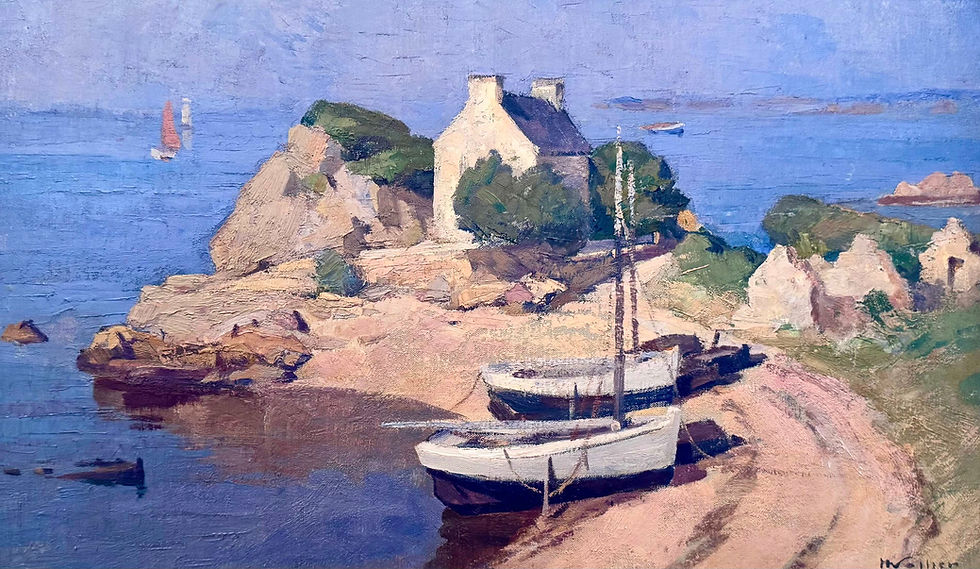
HENRI SOLLIER | Dans les Pins
Signed 'H Sollier' (lower right)
Oil on Canvas
65.5 x 54.5 cms / 25¾ x 21½ inches
This pastoral composition reflects a sensitivity to countryside architecture and seasonal change. Inspired by quiet rural paths, the artist employs loose, layered brushwork to integrate stone, foliage and sky. The technique favours soft edges and tonal harmony, creating an atmospheric scene that evokes familiarity, calm and the slow passage of time.
Henri Sollier was born in Bagnolet, on the outskirts of Paris, in 1886. In 1906 he enrolled at the prestigious Académie Julian, and within two years was accept into the nation École des Beaux-Arts. With this impeccable training behind him, Sollier was quickly accepted into the studios of well-known academic painters such as François Flameng and François Schommer. In the immediate aftermath of the Great War, Sollier exhibited two patriotic canvases at the Galerie Devambez in Paris. Such was the success of the work that the young artist immediately became a recognised presence at the Salons. By the early 1920s Sollier’s success had given him enough financial stability that he began to travel to Senegal to paint scenes of French West Africa; his new subject matter would see him rewarded with the Prix de l’Afrique Occidentale Française. For most of the 1920s he continued in this vein, exhibiting in both Paris and Dakar.
Sollier’s style would see a second dramatic change in 1929, when he went visited the Breton coast for the first time. He found the coast around Finistère and Morbihan so alluring that it quickly became his favoured subject matter. His early works in the 1930s sought to capture Brittany and its people in a social realist style: many of his works focused on the Breton people, farmers, and markets. By the middle of the decade, he had transitioned to painting landscapes and seascapes: using broad brushstrokes and warm tones, his works celebrate the beauty of the rugged Breton coast.
By the late 1930s Sollier was widely regarded as one of the best painters working in Brittany: in 1937 he was made both a committee and jury member of the Salon des Artistes Français after receiving a gold medal at that year’s exposition. In later life, his style would change again: in the 1940s and 50s most of his output were mythological paintings. He passed away at his easel in 1966.
- Free shipping for artworks above £5,000 in the UK. For International customers please contact us for a shipping quote.